Thursday, November 4, 2021

JASDF F-2 fighter lost canopy inflight during scramble in October because its pilot forgot to lock it before take-off


A JASDF F-2 fighter jet that scrambled from Tsuiki Airbase on Oct. 10, 2021 lost its canopy inflight while the jet was over the vicinity of Asakura city during a scramble mission.

There were no reports of any injuries or property damage after the mishap.

The fighter also lost a ladder weighing about 480 grams, with which the aircraft was equipped.

The photo in this post was taken after the F-2 made an emergency landing at Tsuiki Air Base.

According to Alert 5, investigations into the incident had found that the pilot had failed to lock the canopy before take-off.

The pilot was supposed to check the warning lights before take-off but he had failed to do so.

After the incident, the JASDF conducted inspections of all aircraft and to see if any other parts have fallen from the F-2 fighter.

“We are sorry for causing concern to local residents and the general public,” the ministry said. Chief Cabinet Secretary Hirokazu Matsuno said on Oct. 11, 2021 the mishap was serious as it could have posed great danger to local people.

Based on the design of the Lockheed Martin F-16 Fighting Falcon, the F-2 is capable of both air-to-air and air-to-surface roles though it is optimized for the latter role, to protect Japan’s sea lanes.

The F-2 has a wing area that is enlarged approximately 25 percent over the F-16 wing area. The larger wing allows more internal fuel storage and two more weapon store stations than the F-16. Japan elected to fabricate the wing substructure using graphite epoxy and by applying state-of-the-art co-cured composite technology to maximize the strength while minimizing the weight. In addition to the larger wing area, the F-2 fuselage is approximately 17 inches longer than that of the F-16. The horizontal tails are also larger.

Significant hallmarks of the program are the technology transfer and workshare between Japan and the US. The F-2 have been jointly developed and jointly produced by Mitsubishi Heavy Industries and Lockheed Martin. Japan is responsible for producing approximately 60 percent of the aircraft, and the US is responsible for producing approximately 40 percent.

An on-board look at India’s first-ever indigenous aircraft carrier, INS Vikrant

Elbit Systems / TORCH-X™ BORDERS

This Swedish Designed Fighter Proved That China’s Air Force Is Far From Invincible

Elbit Systems C4I & Cyber

Tuesday, November 2, 2021

Lockheed Martin and Verizon: Connecting the Battlespace of the Future with 5G.MIL™ Technology

US Army Black Lions Stand Ready to Face Any Threat

Message from Russian and Chinese Naval Exercises


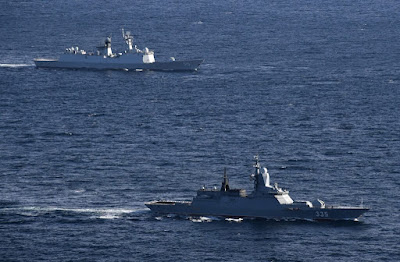
Participating in Joint Sea 2021 from PLAN : Type 055 destroyer Nanchang, Type 052D destroyer Kunming, Type 054A frigates Binzhou and Liuzhou, and Type 903A supply ship Dongpinghu. From the Russian Navy : destroyer Admiral Panteleev, Steregushchiy-class corvette  Aldar Tsydenzhapov and Gromkiy, two base minesweepers, a submarine Ust- Bolsheretsk (photos : defence.pk)

Russia and China recently conducted a large-scale joint maritime exercise, which could be upgraded to joint air and sea patrols in the future, analysts say.

The warships of the two countries recently passed through the Tsugaru Strait and Japan's Izu island chain, a move that is considered a show of strength before the US and its allies.

“The Chinese and Russian militaries can conduct joint air and sea patrols in the Sea of ​​Japan or the Western Pacific,” said Yue Gang, a retired PLA officer and now a peace activist. military commentary. Mr. Gang said that the two sides can jointly mobilize more modern weapons into the exercises.

“With the mobilization of more modern weapons, the two countries will show more clearly their determination to strengthen coordination as well as demonstrate that they are not hiding anything from each other. Both sides need to strengthen their joint capacity to handle crises or emergencies," Gang said.“China and Russia are showing off their joint patrol capabilities. The two sides have conducted joint air patrols, and the latest is joint patrols at sea. They are trying to show their determination to jointly maintain regional stability,” said former Chinese military lecturer Song Zhongping.

During the last exercise, the Russian and Chinese fleets performed anti-submarine exercises and passed through the narrow Tsugaru Strait between the Japanese islands of Honshu and Hokkaido. The group then headed south and passed the chain of Izu islands while helicopters also took off from the deck.

According to the announcement of the militaries of the two countries, five Russian warships and five Chinese warships participated in this exercise. This is also the first time China has sent the 055-class Nanchang missile destroyer to participate.

Other ships dispatched by China include a 052D destroyer, two 054A frigates and an corvette. Russia sent the Udaloy-class destroyer Admiral Panteleyev, the submarine hunter Admiral Tributs, an electronic surveillance ship and two other destroyers.

China and Russia have periodically cooperated in military exercises since 2012. Since 2019, the two countries have conducted annual joint air patrols in the East China Sea and the Sea of ​​Japan.

Observers believe that Russia and China will increase exercises in the East China Sea and the Sea of ​​Japan in the near future, where both countries have interests. The exercises will likely focus on air defense and anti-ship capabilities.

"The joint deployment of warships by Russia and China is a strong warning to the US and Japan," said former Chinese military lecturer Song Zhongping.

Both Mr. Gang and Song said that the Chinese and Russian militaries are drawing closer together because they are facing increasing external pressure, including the formation of the AUKUS security alliance of the US, UK and US trio. Australia, along with the expanded role of the "Quad" with members including Japan, India, the US and Australia.

“These things pose a relatively serious threat to China, even Russia. Beijing and Moscow urgently need to strengthen mutual trust on the military front, step up joint exercises and strategic cooperation," Song said.

LinkWithin

Related Posts Plugin for WordPress, Blogger...